Thursday, November 19, 2009
Behind The Scenes: Photoshoot: Vargas Family [11/14/09]
All photos taken by Paul Borromeo
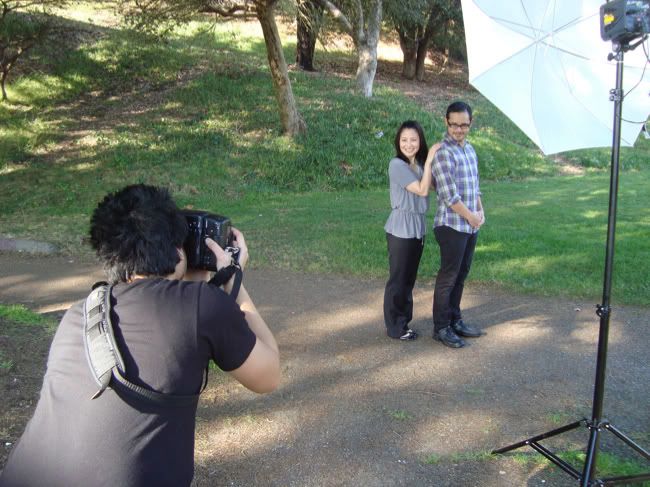
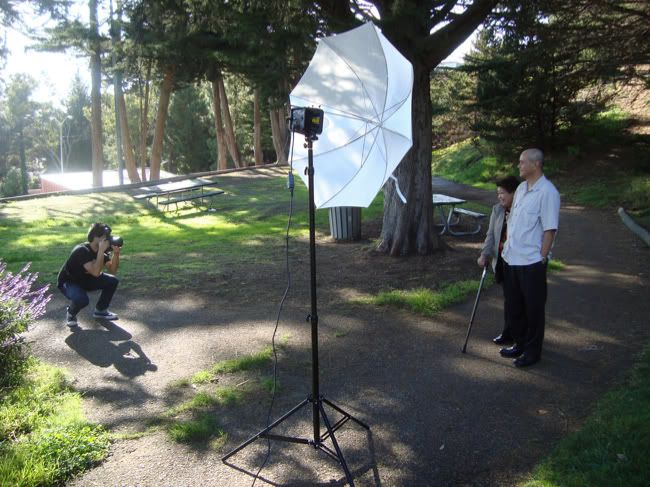
One of the first weekend of my "Family and Friends Portrait Promo" was with my friend Joal and his fam. He decided to take them at Hillside Park since he also wanted to show his parents where he works [there's a clubhouse there as well].
We did the usual family group shots and then couple shots.
This part of the shoot was one of my favorites. I need to time to show the results!
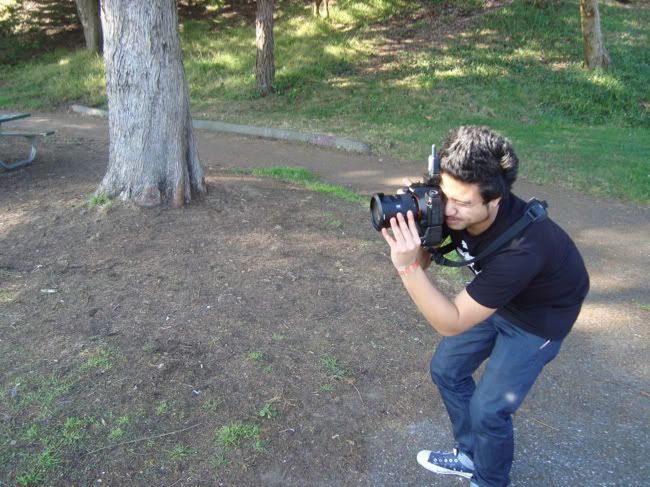
Me working.
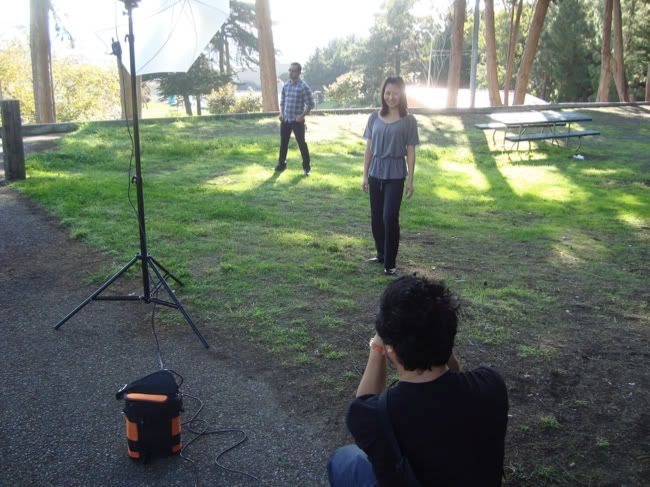
Joal and Amy pose for a bit as Joal's parents waited in the car.. it was friggin cold despite the sun!
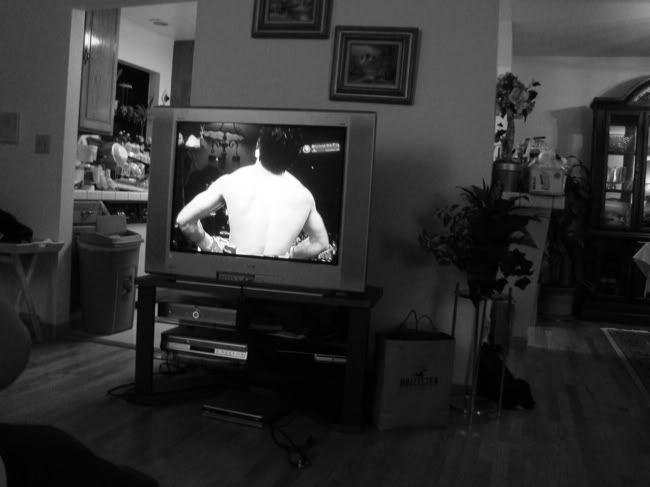
ADLs: Manny Wins [Again]
Taken on November 14, 2009
Manny Pacquiao wins over Miguel Cotto in the 12th round as my family watches in joy and celebration.
--
The blog roll "ADLs" is a series of images of my "Activities of Daily Living". Yes, that's a nursing term so it's fitting for where I am now--nursing student about to graduate with a passion for photography. A new post is expected to be up everyday.
Wednesday, November 18, 2009
What I've Learned In Nursing: "The 5 Rights"
The 5 Rights
In nursing, part of the care is medication administration. In order to be safe, we were taught in the very beginning when our clinicals started about "The 5 Rights." These rights were: right medication, right dose, right time, right patient, right route. The order didn't matter too much but just as long as you, the nursing student, checked these "rights" prior to giving the medication.
Like in all things in nursing, it is very important to put the patient's safety as the priority. If I were to give a patient too much of a drug [or too little], or too soon [or too late], or to the wrong patient and/or route, well things can go very wrong.
These 5 Rights have been ingrained ever since in order to make sure what we give to patients as nurses are 100% correct. Yes, no room for error and I totally agree.
To tie this to the "other side of the road"--life outside of nursing--I'd still say we have a certain "5 Rights" to abide to. For me, the equivalent to the nurse's 5 Rights [of drug administration] would be the right who, right what, right where, right when, and why.
WHO
Who you are as a person greatly affects the people and situation around you. When you're attitude is unfitting, people just don't want to be there with you. Being positive is hard in all situations, but never stop trying. If you're a good at anything [even just being a good person in general], like what my good friend Lauren says, "Let it be known."WHAT
What you do is always important--big or small. In Paul Arden's book Whatever You Think, Think The Opposite, there is a part that describes a street sweeper. "He wasn't just a street sweeper; he was the best street sweeper."
WHERE
I remember Brother Draper, the dean of students at my high school, always gave his speech on how students get in trouble in the beginning of the year. He'd say, "Wrong place, wrong time." Sometimes you can control the situation and change it and other times where you are is out of control. How you respond to either situations will be the result of who you are and what you can do.
WHEN
Timing is everything. If you're late for a meeting [with anyone], what does that say about you? When you remember to call a friend for her birthday, surely you are to be remembered for that gesture. Why are you saving that unused _____ [fill in the blank i.e. tshirt, box of pens, candle, etc], what are you saving it for?
To quote a good movie of mine, Kung Fu Panda:
"Yesterday is history, tomorrow is a mystery, but today is a gift. That is why it is called the "present." - Oogway
Timing is everything, so make it count.
WHY
My favorite word that in itself is a question. Asking "why?" can only bring answers to curiosity and solutions to problems [and annoyance if asked to much... remember asking this repeatedly as a kid?]
To understand is to question. To question is to find an answer. To find an answer is to ask again "why?" until it can no longer be explained.
I want to be a great photographer.
Why?
I love producing creative images and would want to do it for a living.
Why?
Being paid to be creative would be a dream.
Why?
To face reality of working on a schedule would not seem so fun.
Why?
Because I want time in my life to enjoy it and spend it with the people around me.
Why?
Because I find happiness in the people around me.
Why?
Being successful is nothing if you can't share it with anyone.
OK, you get the picture. Asking why can reveal many things even if you weren't set out to find that particular answer. [This short exercise for me at 2am was answered without plan].
--
WILIN "What I've Learned in Nursing" is a new blog reel that takes bits and pieces from what I've learned as a nursing student at University of San Francisco (c/o Fall 2009) and apply it to the rest of the real world. It is my attempt now to "combine" photography and nursing as many people have suggested who know I am conflicted with nursing and photography as a job/career.
Saturday, November 14, 2009
Behind The Scenes: Photoshoot: Amanda [11/06/2009]
All photos by Gee Bantay
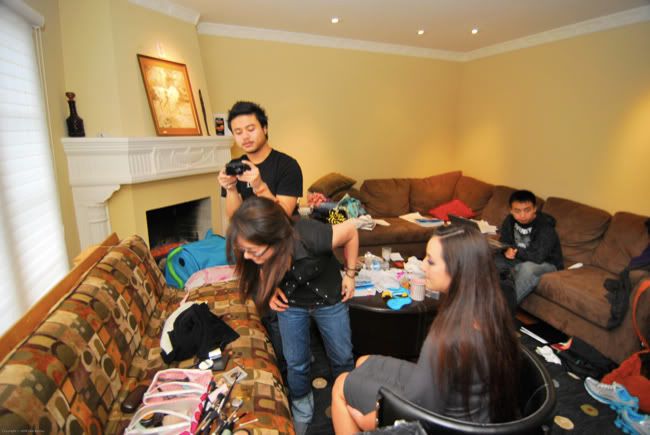
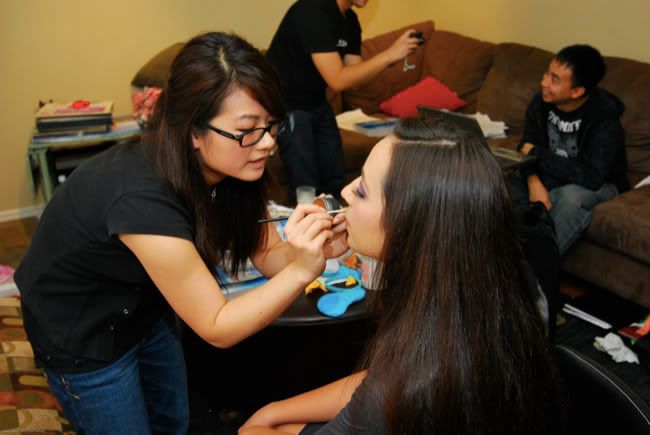
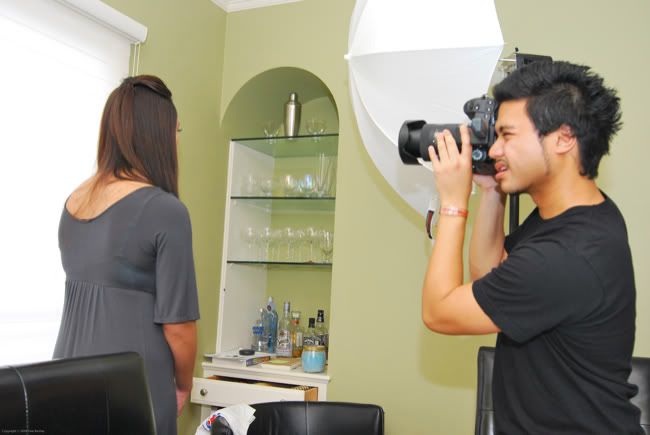
Despite being a raining day in San Francisco, we keep our hopes up and proceed with the photoshoot. Here, my friend and make up artist Karen Wan apply make up on my USF classmate Amanda Clark. I'm also taking behind the scene photos on my personal camera.
I'm in the background there video recording my other classmate Tin who's there at the house studying for our exam the next day.
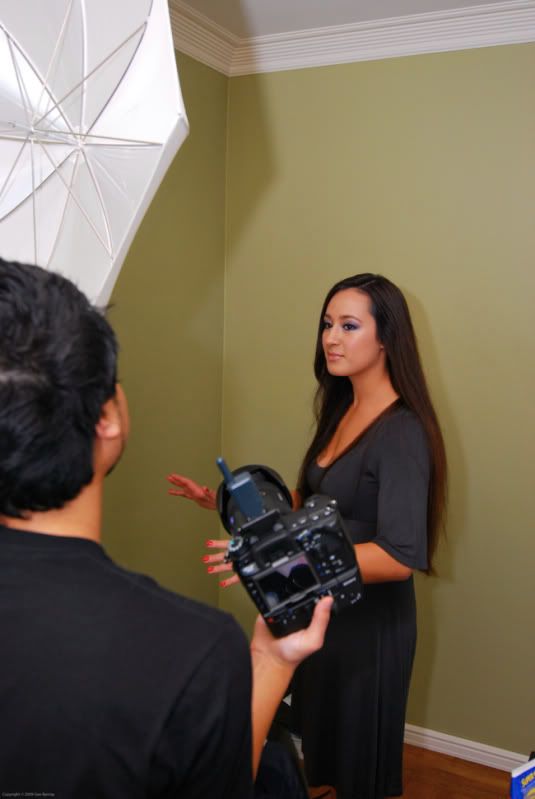
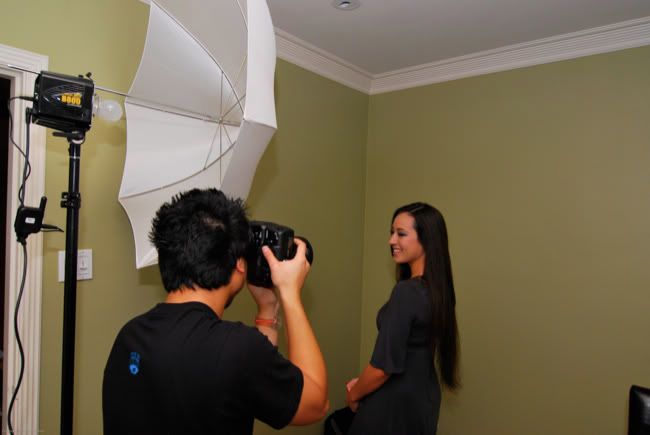
We finally get going with the shoot and here I am using the Carl Zeiss 24-70 2.8 lens for an official shoot with my Sony a700 camera.
We use Amanda's house as makeshift "studio" using the wall and blinds as the main background.
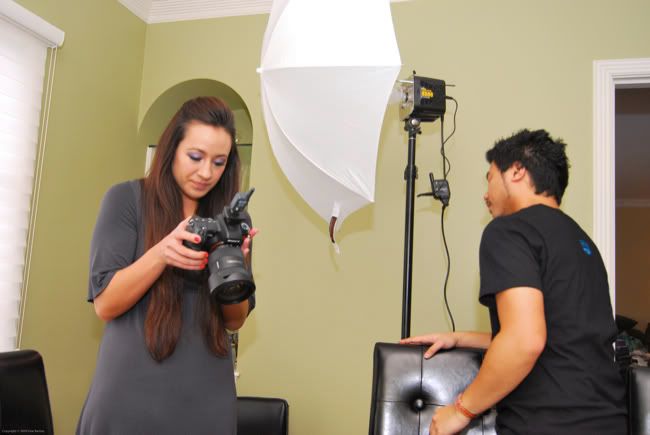
Lights used: single Alien Bees B800 with a 32" shoot through white umbrella triggered by Alien Bees Cybersync remotes.
Amanda reviews some of the photos as I rearrange myself for a more comfortable position.
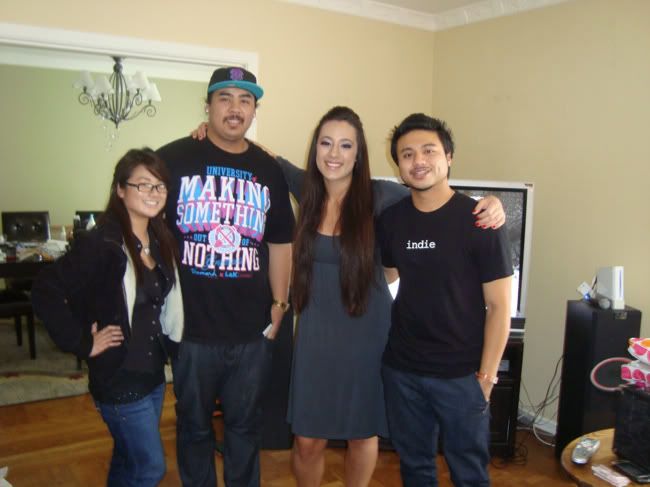
Today's team (left to right): Karen Wan [make up], Gee Bantay [assistant], Amanda Clark [talent], and myself.
Thanks again to Karen for the make up and Gee for helping and taking the behind the scene photos.
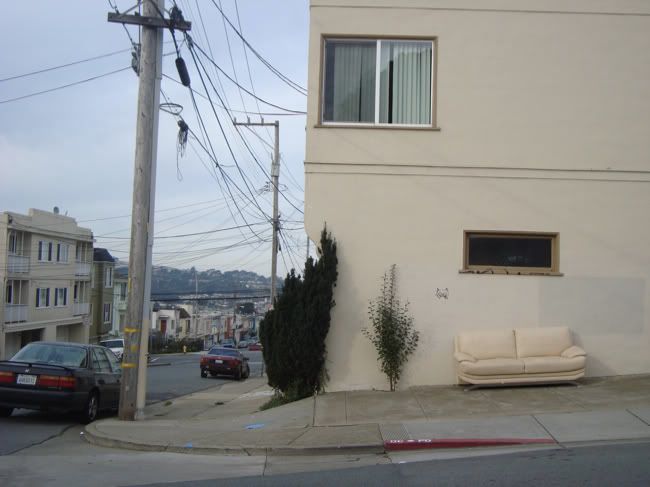
Abbot and East Moltke: "Couch"
--
Abbot and East Moltke is an on-going project documenting the various items left by households at the corner of where I live. Different items have been left already and some of which I've already unfortunately missed. This photo series will continue for an unknown period of time and is planned to be [self] published once body of work is completed.
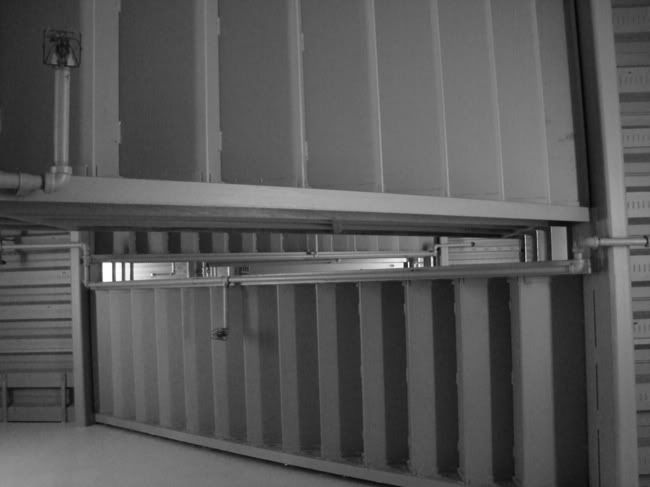
ADLs: Endless Stairs
Taken at Stanford Hospital, November 9, 2009
I decided to take the stairs to ground level since it would be faster than an elevator [plus I need the exercise!] When I looked up it quickly reminded me of one of M.C. Escher's works.
--
The blog roll "ADLs" is a series of images of my "Activities of Daily Living". Yes, that's a nursing term so it's fitting for where I am now--nursing student about to graduate with a passion for photography. A new post is expected to be up everyday.
Sunday, November 8, 2009
Senior Portraits for $45 (USF Senior Students Only)
click to enlargeApplicable to only University of San Francisco class seniors: Senior Portrait sessions for only $45! All sessions are 1.5 hours and are on-location. Each session includes a Starter Print Package (4 wallets and 1 5x7) when $15 worth of prints are purchased. Make Up Artist is available for $25 extra.
For more pictures of classmate Amanda, please go to my website at jcasasphotography.com
If you have any questions or need any more details, contact me! Spaces are limited.
For more pictures of classmate Amanda, please go to my website at jcasasphotography.com
If you have any questions or need any more details, contact me! Spaces are limited.
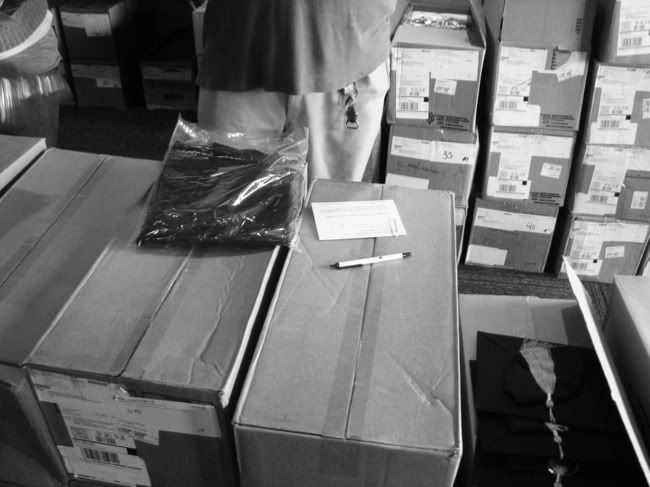
ADLs: Cap and Gown
Taken at University of San Francisco, Fromm Hall
Not the typical "cap and gown" picture but it is a picture of it as I picked it up today at school. My days are numbered at USF as a nursing student but it still hasn't really settled on me yet. There's still unfinished business that I need to take care [notably my HESI exam which is equivalent to my real ticket out of here].
Let's hope the upcoming one is it.
--
The blog roll "ADLs" is a series of images of my "Activities of Daily Living". Yes, that's a nursing term so it's fitting for where I am now--nursing student about to graduate with a passion for photography. A new post is expected to be up everyday.
Friday, November 6, 2009
Review: Initial Impression on X-Rite ColorChecker Passport
Anyways, this thing could have been handy today since I had a quick photoshoot with a classmate [more on that in the next post]. Basically, X-Rite, known for its color calibration software and hardware released their ColorChecker color swatch but in a more portable solution.
Detailed shot of the descriptive panels of the X-Rite ColorChecker Passport.
Pictured above is the Creative Enhancement and Color Target.
It is pretty straight forward as the instructions go: make sure you shoot with your X-Rite ColorChecker Passport in every situation you change lighting [in RAW]. Import that to Lightroom [or convert the reference shot into DNG file, Adobe's standard RAW file] to ColorChecker Passport and it will ideally recognize the swatches and make a custom profile for that point of time in the photoshoot. From there, you just have to apply that custom profile to all images with that lighting situation. Repeat when the lighting situation changes.
Below are samples with and without it. If you haven't noticed already, the first picture in this entry has already used the X-Rite ColorChecker Passport. Although it is meant for RAW files, I actually used it with the JPEGs from my point and shoot Sony Cybershot W120 digital camera. Although it's not intended for JPEGs, I'm glad that is works as good!
SO: Is it worth it?
If you understand the importance of color corrected images, YES. If you have other means of getting your corrected white balance--that white lens cap, ExpoDisc, a piece of white paper, WhiBal [which I actually own and had to use today for my shoot]--then see first if you have a reason to upgrade and use an actual color swatch.
For me, I've used the WhiBal although not extensively, but will admit it works [as I used it today]. I do have a yearning to achieve more accurate color and really present images accurately. In some situations, it might change since I'll do some post production on some but in general, I'd like to keep this type of workflow.
Even just using this for a bit with my pocket camera you can already see a drastic improvement in image quality. If these images gained something from using it, imagine an important shoot! Truly you'll want to put forth the best looking pictures and files to that client.
Why not just set White Balance in camera?
Ideally yes you should! But when you're shooting RAW, you'll have to do that all over again because you get full control of your images and set your White Balance again (at least with my Sony RAW files). So if you don't have a reference point, you'll be guessing on your images and will have inconsistent colors in your images. And yes, that has happen to me in some occasions where I just had to guesstimate a "right" white color balance.
Why not just use anything white?
You actually could but I personally wouldn't [for a corrected white balance]. For example, when I really had to, I used a white piece of paper but that piece of paper isn't neutral. I got an OK white balance but if I were to use that across a series of images it would look horrible! Having something that is neutral is important for consistent white balance corrected images.
So you said you have the WhiBal, so why get this?
Because I'm always into the latest and greatest.
Ok that's partly true but for me, the WhiBal isn't as flexible as the ColorChecker Passport. The WhiBal is really meant for well, white balance. I have the credit card sized version and it's lightweight, extremely portable and useful.
The Passport allows me to white balance images in addition to warm and cool portraits, landscapes, and color correct images correctly--not just white balance basically. For me, it provides a complete color evaluation tool to get the most out of your digital sensor.
In Conclusion I personally will be going to like using this tool in my shoots as it gives me a sense of greater control of my images. Besides looking cool using one of course. For its price (a cool $99), any tool is far worth its MSRP value if you need it, utilize it, and ultimately gain from it.
For me, it's all of the above.

Thursday, November 5, 2009
ADLs: Library's View (John Daly Library, Daly City)
Taken at John Daly Public Library in Daly City
I take a quick break from studying [for my exam this Saturday!] and take a quick shot of where I was sitting and the view available to my right.
--
The blog roll "ADLs" is a series of images of my "Activities of Daily Living". Yes, that's a nursing term so it's fitting for where I am now--nursing student about to graduate with a passion for photography. A new post is expected to be up everyday.
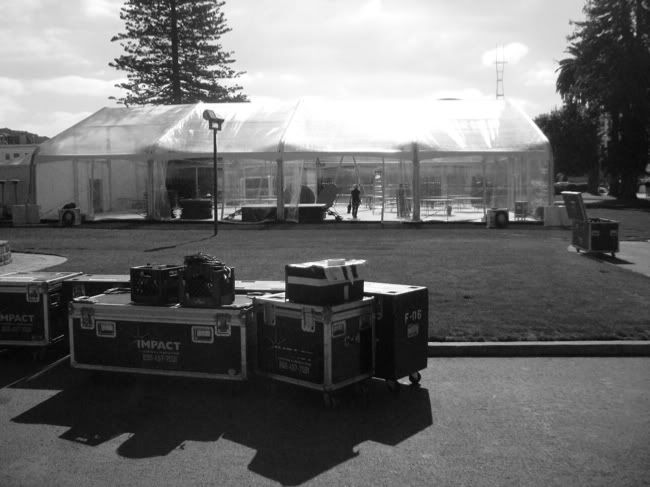
ADLs: Why Not Party on a Lawn
Taken November 4, 2009 at University of San Francisco
On my way to class and see this event being prepared outdoors on USF's lawn [in front of the church and class buildings]. I'm sure they're spending a lot for this--several power generators, tables/chairs/decor, sure there's gonna be food/catering and oh, this large translucent tent.
--
The blog roll "ADLs" is a series of images of my "Activities of Daily Living". Yes, that's a nursing term so it's fitting for where I am now--nursing student about to graduate with a passion for photography. A new post is expected to be up everyday.
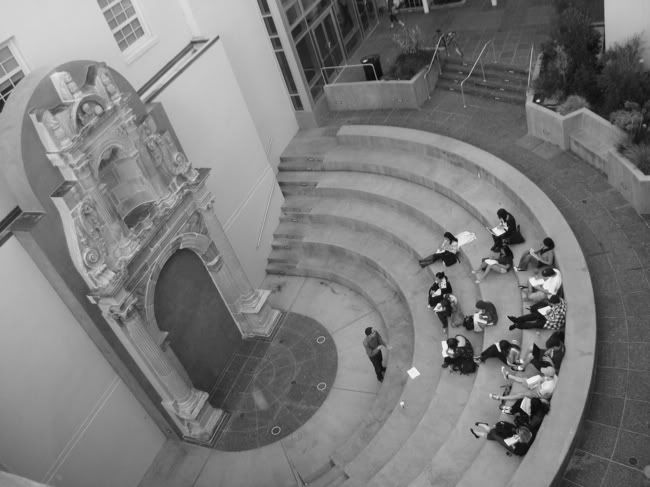
ADLs: A DIfferent Classroom (University of San Francisco)
Taken November 3, 2009 at University of San Francisco
On my way to the bathroom from a tutoring session, I look out the window in the staircase and see a class being conducted in the new area that was completed this past Summer. Something fresh like this is bound to stimulate new perspectives and ideas from students and teacher alike.
--
The blog roll "ADLs" is a series of images of my "Activities of Daily Living". Yes, that's a nursing term so it's fitting for where I am now--nursing student about to graduate with a passion for photography. A new post is expected to be up everyday.
Tuesday, November 3, 2009
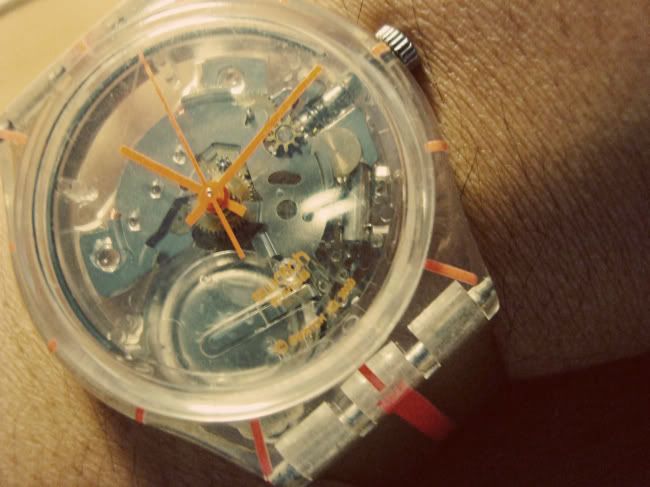
What I've Learned In Nursing: "Time Keeper"
This marks my first posting for my new blog reel [in addition to Abbot and East Moltke and ADLs] entitled "What I've Learned in Nursing"--for short: WILIN.
This new series is to take bits and pieces from what I've learned as a nursing student at University of San Francisco and apply it to the rest of the real world. It is my attempt now to "combine" photography and nursing as many people have suggested who know I am conflicted with nursing and photography as a job/career.
This first post is entitled:
Time Keeper
At 2000 (8:00pm) I'll need to give a drug. Every hour I'll need to check another patient's PCA [patient controlled analgesia] machine. By 2200 (10:00pm) I'll need to call the doctor to report my vital signs for a patient. And oh, I've still got until 0700 (7:00am) until I'm out of here.
First off, get a watch. I don't care if you use your phone as your main time keeper. You still need to reach into your pocket or your hip to look at time when simply a flick of your wrist you'll have the time. I don't care if you invest in a timeless piece (pun intended) or a cheap plastic watch. Look cool with one or not. Two, look at it more often.
You ever been late to a meeting? You ever forgot about that lunch you were suppose to have with a friend? Or how about, do you not know what time it is right now? I can say it would be simple to just have a watch and it will solve everything but at least that's one part to the equation.
You still need to be organized, efficient, and oh, be able to manage time effectively in the real world.
For nursing, time is always against you (some may argue with you). You have to do this, do that, more of that, maybe that if I could, all within a time frame--either an 8 hour shift or a 12 hour shift. You receive report from the previous shift's nurse, decide then what's needed to do, attend to the patient's medications and tasks, and finally report all what you did for the next shift's nurse. You can either be rushing to get this all done (worst part since you don't got a break) or relaxing too much (worst part since you could be doing something for the patient).
What I've learned since Fall 2005 [when I begun nursing] is to be organized and efficient with my time. But that's such a plain and simple concept that we've all learned from the beginning right? Well, fast forward today, it's not just how you are organized and efficient but also how you are able to prioritize things.
Who will you see first? A patient with an oxygen saturation of 92% or a febrile patient with a temperature of 38.2 degrees Celsius?
What will you do first in the morning? Afternoon? Your next meeting? Your anniversary? Etc. What you choose to do/accomplish first is important. To set priority correctly is to begin everything correctly.
And the obvious by the way? Keep time of birthdays, anniversaries, and any other special occasions. Always. Never forget to greet anyone close to you. No excuse from here on. And oh, no more email/electronic wishes. Call them. You have a cell phone with enough minutes to spare them a 5 minute phone call.
How to be a "Time Keeper"
To be a "Time Keeper" is knowing where you are in the day, what you've accomplished, what you still need to accomplish, and begin to think what you need to do for tomorrow, Sunday, and next week.
To be a "Time Keeper" is to effectively use a calendar--a planner, your phone, etc--to keep track of assignments, birthdays, events, etc.
With the accessibility of today's technology (cell phones, Google Calendar, Outlook, iCal, etc) there's no excuse as to why you aren't using a calendar. I personally use a Moleskine Day Planner and Google Calendar.
The importance of being a "Time Keeper" is keeping check in your progress of what you've accomplished and what you didn't. I started keeping a Moleskine Day Planner since last year and I can tell you exactly what I did November 03, 2008 (which I just looked up: went to Starbucks with my cousin and later saw our friend Dar to discuss a photoshoot for Kidheroes.net product line while missing my shipment of my Alien Bees lights).
To be a "Time Keeper" is to remember what you've done, what you're doing, and what you're going to be doing.
And oh, to know what time it is with that watch of yours..
--
WILIN "What I've Learned in Nursing" is a new blog reel that takes bits and pieces from what I've learned as a nursing student at University of San Francisco (c/o Fall 2009) and apply it to the rest of the real world. It is my attempt now to "combine" photography and nursing as many people have suggested who know I am conflicted with nursing and photography as a job/career.
This new series is to take bits and pieces from what I've learned as a nursing student at University of San Francisco and apply it to the rest of the real world. It is my attempt now to "combine" photography and nursing as many people have suggested who know I am conflicted with nursing and photography as a job/career.
This first post is entitled:
Time Keeper
At 2000 (8:00pm) I'll need to give a drug. Every hour I'll need to check another patient's PCA [patient controlled analgesia] machine. By 2200 (10:00pm) I'll need to call the doctor to report my vital signs for a patient. And oh, I've still got until 0700 (7:00am) until I'm out of here.
First off, get a watch. I don't care if you use your phone as your main time keeper. You still need to reach into your pocket or your hip to look at time when simply a flick of your wrist you'll have the time. I don't care if you invest in a timeless piece (pun intended) or a cheap plastic watch. Look cool with one or not. Two, look at it more often.
You ever been late to a meeting? You ever forgot about that lunch you were suppose to have with a friend? Or how about, do you not know what time it is right now? I can say it would be simple to just have a watch and it will solve everything but at least that's one part to the equation.
You still need to be organized, efficient, and oh, be able to manage time effectively in the real world.
For nursing, time is always against you (some may argue with you). You have to do this, do that, more of that, maybe that if I could, all within a time frame--either an 8 hour shift or a 12 hour shift. You receive report from the previous shift's nurse, decide then what's needed to do, attend to the patient's medications and tasks, and finally report all what you did for the next shift's nurse. You can either be rushing to get this all done (worst part since you don't got a break) or relaxing too much (worst part since you could be doing something for the patient).
What I've learned since Fall 2005 [when I begun nursing] is to be organized and efficient with my time. But that's such a plain and simple concept that we've all learned from the beginning right? Well, fast forward today, it's not just how you are organized and efficient but also how you are able to prioritize things.
Who will you see first? A patient with an oxygen saturation of 92% or a febrile patient with a temperature of 38.2 degrees Celsius?
What will you do first in the morning? Afternoon? Your next meeting? Your anniversary? Etc. What you choose to do/accomplish first is important. To set priority correctly is to begin everything correctly.
And the obvious by the way? Keep time of birthdays, anniversaries, and any other special occasions. Always. Never forget to greet anyone close to you. No excuse from here on. And oh, no more email/electronic wishes. Call them. You have a cell phone with enough minutes to spare them a 5 minute phone call.
How to be a "Time Keeper"
To be a "Time Keeper" is knowing where you are in the day, what you've accomplished, what you still need to accomplish, and begin to think what you need to do for tomorrow, Sunday, and next week.
To be a "Time Keeper" is to effectively use a calendar--a planner, your phone, etc--to keep track of assignments, birthdays, events, etc.
With the accessibility of today's technology (cell phones, Google Calendar, Outlook, iCal, etc) there's no excuse as to why you aren't using a calendar. I personally use a Moleskine Day Planner and Google Calendar.
The importance of being a "Time Keeper" is keeping check in your progress of what you've accomplished and what you didn't. I started keeping a Moleskine Day Planner since last year and I can tell you exactly what I did November 03, 2008 (which I just looked up: went to Starbucks with my cousin and later saw our friend Dar to discuss a photoshoot for Kidheroes.net product line while missing my shipment of my Alien Bees lights).
To be a "Time Keeper" is to remember what you've done, what you're doing, and what you're going to be doing.
And oh, to know what time it is with that watch of yours..
--
WILIN "What I've Learned in Nursing" is a new blog reel that takes bits and pieces from what I've learned as a nursing student at University of San Francisco (c/o Fall 2009) and apply it to the rest of the real world. It is my attempt now to "combine" photography and nursing as many people have suggested who know I am conflicted with nursing and photography as a job/career.
ADLs: Glass of Water
Sunday, November 1, 2009
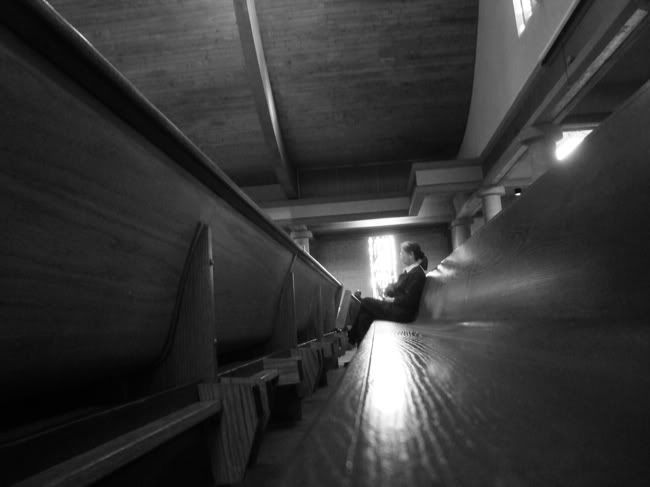
ADLs: Sunday Morning
"Sunday Morning"
A quick "hip-shot" of a lady in church this morning. I know, I'm suppose to be paying attention but I was late coming in today and thought I'd fire a quick shot.
--
The blog roll "ADLs" is a series of images of my "Activities of Daily Living". Yes, that's a nursing term so it's fitting for where I am now--nursing student about to graduate with a passion for photography. A new post is expected to be up everyday.
Subscribe to:
Comments (Atom)